January 9, 2025
Did you know that there are several types of curiosity held by humans? Neither did I.
As a curious person who often jumps down internet “rabbit holes,” my exploration led me to various articles on curiosity. My exploration landed on Daniel Berlyne. Berlyne was a leading 20th century world renowned experimental psychologist. In the 1950’s, Berlyne was one of the first psychologists to offer a comprehensive model of curiosity.
According to an article “The Five Dimensions of Curiosity,” psychologists have compiled a large body of research on curiosity and its benefits. Since the 1950s, psychologists have offered up competing theories about what makes a person curious. One of the leading minds was Berlyne.
Berlyne noted that curiosity is a primary driver of exploration. Berlyne was the first to offer a comprehensive model of curiosity. He concluded that diversive curiosity occurs when a bored person searches for something-anything-to boost arousal. There is also specific curiosity that happens when a hyper-stimulated person tries to understand what’s happening in order to reduce arousal to a more managed level.
Berlyne was a British and Canadian psychologist, born in Britain in April 1924. Berlyne graduated from Cambridge University with a B.A. in 1947, and an M.A. in 1949. Berlyne first worked in academics at St. Andrews University in Scotland. In 1951, Berlyne left Scotland to pursue his Ph.D. at Yale University in the United States. During his career, Berlyne worked at several universities in Canada and the United States. He specialized in the field of experimental and exploratory psychology.
He wrote or co-authored seven books and 150 journal articles and book chapters. He was honored as Fellow of the Royal Society of Canada, Fellow of the British Psychological association, and lectured at universities on four different continents. He served as President of the Canadian Psychological Association from 1971-72. Those are just a few of the honors that Berlyne earned.
Berlyne made considerable amount time to the study of curiosity. He wanted to know why various species displayed curiosity, and what motivates them to explore their environments. According to the American Journal of Psychology, Berlyne’s most important single work was in his 1960 book, Conflict, Arousal and Curiosity. This book was the “tour de force” and influenced so many in the fields of psychology. Berlyn’s view was ahead of his time.
Writers John J. Furedy and Christine Furedy characterized Berlyne as a maverick, because of his independence of thought and research methods he utilized. Based on interview material and other resources, the Furedys collected and studied, they concluded that Berlyne was extremely interested in ideas for their own sakes. Berlyne’s independent trait showed up in his teaching as well. Much of the content of the post-doctoral students’ work is related to what Berlyne was concerned about at the time. Yet, there was little similarity in form of thought or methods among his students. Berlyne spent considerable time and energy teaching his peers and students how to do research. Berlyne marched to his own drumbeat. Berlyne died young at the age of fifty-two in 1976 after a prolonged illness and many operations. Berlyne’s research lives on and has influenced many other generations interested in his work.
Resources:
American Journal of Psychology, March 1978, Vol. 91, no.1, pp 133-137
Hayden, Benjamin, and Celeste Kidd. “The Psychology and Neuroscience of Curiosity.” Retrieved on 1/2/2025 from
Furedy, John J. and Christine P Furedy, “Daniel Berlyne and psychonomy; the bear of a different drum.” Bulletin of the Psychonomic Society, 1979. 13 (4), 203-205.
Kashdan, Todd B, David J. Disaboto, Fallon R Goodman, and Carl Naughton. “The Five Dimensions of Curiosity.” Harvard Business Review. September-October 2018 *(the magazine) https://hbr.org/2018/09/the-five-dimensions-of-curiosity retrieved on 1/3/2025.
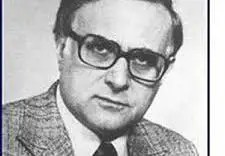
British Psychologist Daniel Berlyne
 Curious and Creative
Leave a comment