6/29/2026
Have you heard the following being said?
“Oh, my God, what were you thinking?!”
“I cannot believe you said that out loud.”
“Wow, how can you not be embarrassed?”
What is sad is that I have said to myself over the years. You have said some similar things to yourself. I am conscientious about what I say to others. If I heard such words being spoken to another I would speak out and call out the behavior. Why then is it so hard to call myself out on such self-talk? I am still trying to figure that out.
“Negative self-talk refers to your inner voice making critical, negative or punishing comments,” wrote Elizabeth Scott, Ph.D. Added that the talk is pessimistic, mean-spirited, or unfairly critical that go through your head on a loop when you make judgements about yourself.
Admittedly, some of my self-talk has not been helpful. More often, it is self-critical. It has not been easy to tame that mean inner voice/critic. I must remind self that when I speak to myself meanly, unkindly, and disparagingly, it is disempowering.
“Most of our problems are not real; They’re linguistic,” wrote blogger Darius Foroux. “They exist in the words you use to describe your situation, not in the situation itself.”
As I dove into this topic, I noted there are key aspects of self-talk:
- Impact on your life: negative self-talk can create self-fulfilling prophecies. Whereas positive dialogue supports goal achievement and better mental health.
- Inner critic vs. coach: negative self-talk tends to amplify flaws. However, a constructive coach-like voice can improve your performance.
According to experts, negative self-talk can take different forms such as Here are a few other examples:
- Mean comments: “I can never do anything right.”
- Hopeless statements: “I don’t deserve to be happy.”
- Apathetic Views: “I got a “C” on the test, guess I am not good at math.”
- Defeated attitudes: “That looks hard. I will not be able to do it.”
At first these comments may seem like a realistic view of a situation but may be spiral or devolve into a fear-based worry. “I am so bad at math, I doubt I can get into a good college or any college.”
According to research, excessive rumination is linked to an increased risk of mental health problems such as depression, generalized anxiety disorder, post-traumatic stress disorder, social anxiety, obsessive compulsive disorder, and psychosis.
The way you talk to yourself matters. Your brain believes every word, especially when it is repeated. Your brain is not broken – it is just running on an old program. For example, if you feel stuck, it is because your brain has been wired to repeat this negative internal conversation stated by Jennifer Furse.
Shanette Smith, LMFT commented that, “how you talk to yourself is easily the most important conversation you will ever have. Self-talk shapes how you treat yourself and how you approach and engage the world around you.”
Your inner voice is a powerful tool for self-reflection and planning, but it can also trap you in “negative thought loops,” as psychologist and neuroscientist Ethan Kross calls it.
Author and Podcaster Mel Robbins summarized negative self-talk so well that it struck a nerve in me.
“Negative self-talk is not your truth; it’s your default,” adding, that it is time to shift the way you speak to yourself. The patterns of “I am not good enough,” “Things like that do not happen to me,” or “I always mess things up,” are patterns, not facts. They are habits.
What is the impact of negative self-talk? It can quietly harm your mental health which can make you feel stressed, sad, and even lead to mental health problems like depression and anxiety. The inner critic diminishes self-confidence and motivation. Negative talk cast a dark shadow over personal goals.
The things that we say to ourselves matter, and self-talk can become ingrained in us. We may not always see or think about the implications. Additionally, we may, in fact, dismiss the impact our self-talk has on our lives. Yet, its impact shows up in our mental and physical well-being, wrote Cassandra Troughton.
The words that we use in communication with ourselves can be helpful or harmful, powerful, or disempowering. Negative talk can limit our thinking, lead to perfectionism, feelings of depression, impact on our relationships, and can dose out the flame of ambition.
“One of the most obvious drawbacks of negative self-talk is that it is not positive. This sounds simplistic, but research has shown that positive self-talk is a great predictor of success,” commented Scott.
What has helped for me is giving my inner critic a nickname; I call mine “Annie.” When you name something, it is harder to ignore. It also gives you the opportunity to catch your critic. You then can call out the critic. You will notice when your inner critic says something to you that you do not say to a good friend, family member, or child.
Next time I will share ideas for changing negative self-talk to neutral self-talk and learn ways to cross-examine your inner critic. When self-talk becomes gentler, negative power becomes muted. Eventually we can shift our perspective.
Resources:
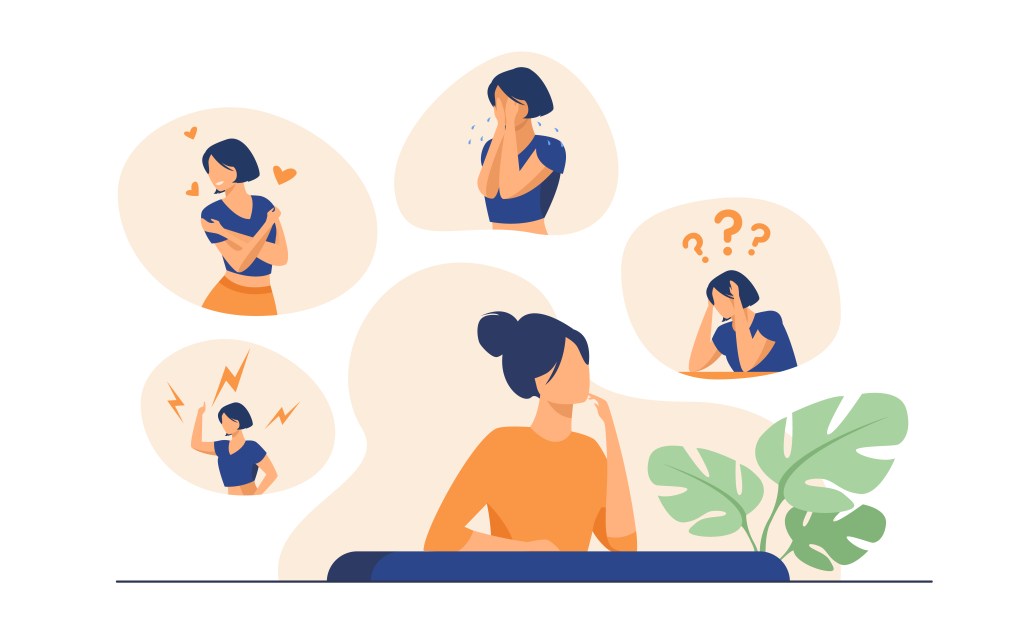
Image by pch. vector on Magnific. Retrieved on 6/29/2026 from https://www.magnific.com/free-vector/woman-expressing-strong-various-feelings-emotions_8271103.htm
Foroux, Darius. “Change Your Words, Change Your Life.” 6/9/2026. Retrieved on 6/28/2026 from https://dariusforoux.medium.com/change-your-words-change-your-life-41d19d7cf6ba
Furse, Jennifer. Video.“Turn OFF Negative Self-Talk with ONE PHRASE: Rewire Your Brain.” 2/20/2025. Retrieved on 5/3/2026 from https://www.youtube.com/shorts/RVNJhi4w31w
GoddessRetreats.com. Video. “Five Positive Self-Talk Tips to Rewire Your Brain.” 1/26/2025. Retrieved on 5/3/2026 from https://www.youtube.com/shorts/UnMJMoKDVC0
Green, Josh. Video. “How to Challenge Negative Self-Talk.” 1/15/2025. Retrieved on 5/3/2026 from https://www.youtube.com/shorts/wsEDeaZjwrc
Kross, Ethan. Video. “Do You Talk to Yourself? Here’s How to Harness Your Inner voice.” Recorded at TED@BCG on September 12, 2024. Retrieved on 5/3/2026 from https://www.youtube.com/watch?v=xb0nLpdWttA
Levoy, Gregg.” Talking Out Loud to Yourself Is not Weird—It’s Advantageous.”1/30/2026. Retrieved on 5/2/2026 from https://www.psychologytoday.com/us/blog/passion/202512/talking-out-loud-to-yourself-isnt-weird-its-advantageous
MacDonald, Maryellen. “How to Talk to Yourself.” 12/10/2025. Retrieved on 5/3/2026 from https://psyche.co/guides/how-to-use-self-talk-to-clarify-your-thinking-and-emotions
Meyers, Joyce. Video. “Transform Your Mood: The Power of Self-Talk.” 7/7/2025. Retrieved on 5/3/2026 from https://www.youtube.com/shorts/IhCMbVw3yqo
Robbins, Mel. Podcast. “Stop Negative Self-Talk, Here’s How.” 6/21/2025. Retrieved on 5/3/2026 from https://www.youtube.com/shorts/tlGnmoL8dqU
Scott, Ph.D. Elizabeth.” The Toxic Effects of Negative Self-Talk.” 4/23/2026. Retrieved on 6/29/2026 from https://www.verywellmind.com/negative-self-talk-and-how-it-affects-us-4161304
Troughton, Cassandra. “Self-Talk: Why What We Say to Ourselves Matters.” 2/22/2023. Retrieved on 5/2/2026 from https://mindfulmisst.com/2023/02/22/self-talk-why-what-we-say-to-ourselves-matters/
Zimmerman, Katie.” Positive Self-Talk Matters.” 4/20/2022. Retrieved on 5/2/2026 from https://thekimfoundation.org/positive-self-talk-matters/


Leave a Reply