(Building Mental Fortitude: Part 6- Emotional Regulation)
“Emotions pile up like a debt,” commented Dr. Marc Brackett, founder and Director of the Yale Center for Emotional Intelligence. “If we don’t know how to express them in ways that are healthy, what happens? The debt comes due.”
What is emotional regulation? Psychology Today defines emotional regulation as the ability to check, evaluate, and change emotional reactions and intensity to fit the demands of situation. It allows a person to respond to stress thoughtfully rather than reacting on impulse.
Why is emotional regulation important?
- It prevents reactive, impulsive responses.
- It sustains emotional balance.
- It supports adaptive coping strategies.
- It strengthens self-control, optimism, and social support.
Therapist Susan McGarvie, Ph.D. wrote that emotions are integral to human experience, while shaping our reactions, decisions, and overall wellbeing. She added, emotional regulation refers to the ability to influence which emotions we feel, when we feel them, and how we express or experience them.
For some of McGarvie’s clients, even recognizing an emotion is difficult, never mind trying to figure out how to influence that emotion. This is particularly true, noted McGarvie, when a person has experienced trauma or chronic persistent stress, in reaction, they may have numbed their emotions to survive.
Emotional regulation is the one area that I have worked so hard on in my life. I heard the comments from family that I am “getting emotional.” Even a week ago, I felt very enthusiastic about a political topic in a dinner conversation with my parents. My father commented “don’t get emotional.” I replied that I was not getting emotionaI; was genuinely concerned about the status of our country and the behavior of government officials. The political discussion shortly ended.
I do my best to reign in my emotions at work and in public, yet I often feel to be myself, I must take off the “mask” that I am wearing. It can be very emotionally exhausting to remain calm and stoic in public when my emotions begin to bubble up and out.
Managing emotions effectively can be particularly tricky, noted by McGarvie, as it is crucial for our mental health and social success. Think of emotional regulation as a bandwidth. With practice, you can do things to widen that bandwidth.
Have you ever said something to someone like a spouse, partner, or friend, then later regretted it? As adults, we are expected to be able to manage our emotions, particularly anxiety and anger, in socially acceptable ways. Sometimes, the emotional controls fail, and we say or do something that we later regret.
“Two broad categories of emotion regulation are reappraisal,” wrote Psychology Today executive editor Lybi Ma, “changing how one thinks about something that prompted an emotion in order to change one’s response — and suppression, which has been linked to more negative outcomes.”
There are two types of regulation, according to Psychology Today.
- Self-regulation: managing your own internal emotional state and behavior.
- Co-regulation: using calm social engagement and support from others to help soothe and balance emotions.
A good example of co-regulation was shown in a recent episode of Ted Lasso, when Coach Lasso sat quietly next to his assistant coach, Alice, to help her calm down after an anxiety attack.
I have worked hard at emotional regulation, particularly trying to model it for my younger son, who is the autism spectrum. Emotional overwhelm can be a factor, even now when either of us is insomnolent, anxious, and stressed. I can be snippy when I get frustrated. I am learning to co-regulate. I will sit next to my son quietly; there are no words, just breaths. I do deep, slow breaths and exhales. Slowly, my son’s breath begins to match mine. He calms down.
According to the Mindset Mentor Podcast, emotional regulation is not an innate, fixed trait. Emotional regulation is a capacity that can be trained through mindfulness, cognitive reappraisal, and deliberate distress tolerance.
“Emotional regulation refers to the processes by which individuals influence their emotions,” according to PsyForU Research International website, “how they experience, express, and manage them. Effective emotional regulation is crucial; it allows individuals to respond to stressful situations thoughtfully rather than reactively.”
According to clinical psychologist Dr. Becky Kennedy, anger, frustration, and emotional blowups are usually treated as problems to eliminate. Kennedy notes they’re signals of something more precise: a missing skill. She reframes emotional regulation not as a personality trait or moral failing, but as a capacity that’s learned through relationships.
According to Psychology Today, there are part skills of emotional regulation:
- Self-awareness is noticing what you feel and naming it.
- Emotional acceptance means accepting the discomfort of negative emotions without judging you; you acknowledge them.
- Cognitive reappraisal is reframing a negative event as a more positive one.
- Distancing means gaining perspective by looking at your situation as a “fly on the wall,” which can be another useful approach.
According to Simply Psychology writer Olivia Guy-Evans, there are other strategies for emotional regulation:
- Name triggers.
- Name the emotion and confirm the emotion.
- Talk through your emotions.
- Journaling.
- Notice when you need a break.
- Good sleep.
- Therapy.
- Meditation and mindfulness.
“People who regulate emotions well don’t avoid feelings,” according to Therapy in a Nutshell, “they build habits that help them pause, process, and respond with intention.”
“Emotional regulation is not about becoming emotionless, detached, or emotionally perfect. Healthy emotional regulation allows individuals to experience emotions honestly while learning how to respond thoughtfully rather than react impulsively.”
― R.E. Geffner MD, Emotional Regulation: Evaluation, Assessment, and Fundamentals in Healthy Relationships
Resources:
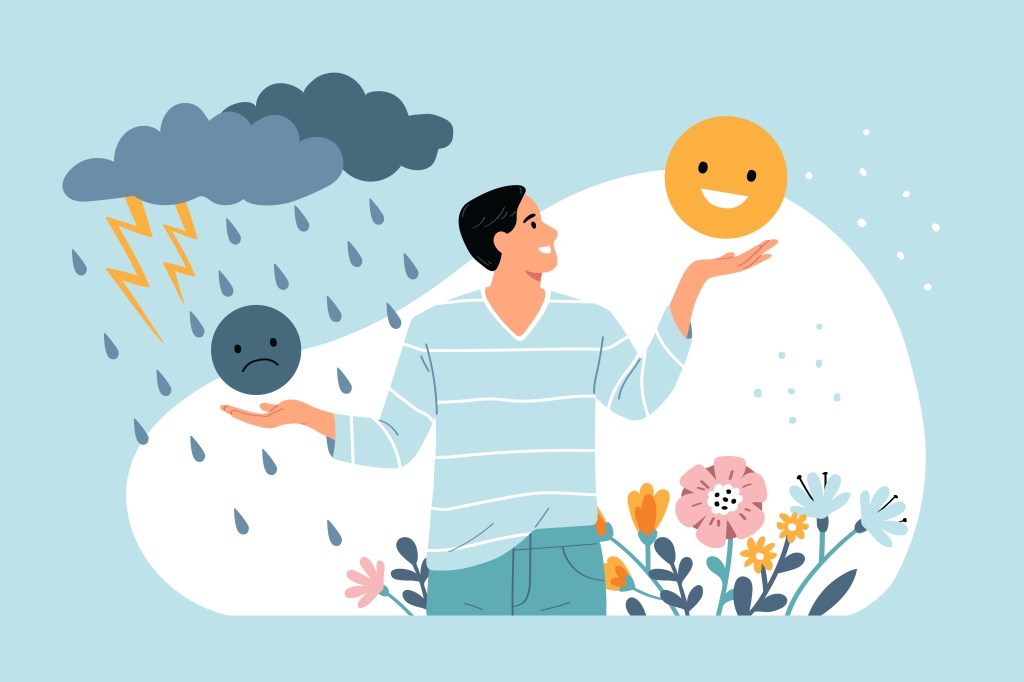
Image by macrovector on Magnific. Retrieved on 10/15/2026 from https://www.magnific.com/free-vector/mental-health-flat-concept-with-man-sadness-positive-symbols-vector-illustration_38754388.htm
Brackett, Ph.D., Marc. “How to Master Your Emotions & Never Get Angry or Bothered by Anyone.” Mel Robbins Podcast. 7/16/2026. Retrieved on https://www.youtube.com/watch?v=SWvHZkkrAjc
Guy-Evans, MSc, Olivia. “Emotional Regulation.” 9/29/2026. Retrieved on 10/14/2026 from https://www.simplypsychology.org/emotional-regulation.html
Kennedy, Ph.D., Becky. “The Crucial Emotional Skills Most Adults Were Never Taught.” 12/30/2025. Retrieved on 10/14/2026 from https://www.youtube.com/watch?v=P67QcUyQ6lU
McGarvie, Ph.D., Susan. “Emotional Regulation: 5 Evidence-Based Regulation Techniques.” Retrieved on 10/12/2026 from https://positivepsychology.com/emotion-regulation/
Ma, Lybi. “Emotional Regulation.” Psychology Today. 9/25/2026. Retrieved on 10/12/2026 from https://www.psychologytoday.com/us/basics/emotion-regulation
Ma, Lybi. “Emotions.” Psychology Today. 9/20/2026. Retrieved on 10/12/2026 from https://www.psychologytoday.com/us/basics/emotions#what-is-emotion-regulation
The Mindset Mentor Podcast. Video. “Anyone Can be Mentally Tough. It’s Easy.” 1/26/2026. Retrieved on 10/12/2026 from https://www.youtube.com/watch?v=LTtyqFX2IJg&t=9s
PsyForU Editorial Collective. “Building Resilience: The Role of Emotional Regulation in Mental Well-Being.” 6/11/2025. Retrieved on 10/12/2026 from https://psyforu.com/building-resilience-the-role-of-emotional-regulation-in-mental-well-being/
Therapy in a Nutshell. “4 Essential Habits for Emotional Regulation.” 6/25/2026. Retrieved on 10/14/2026 from https://www.youtube.com/watch?v=AyP4wujnb0g&t=2s


Leave a Reply